


When comparing property management companies, it's easy to focus on the management percentage. After all, if one company charges 5% and another charges 8%, why would you want to pay more?
It's a reasonable question.
But property management fees pay for much more than rent collection. They fund the people, systems and processes responsible for looking after what is often one of a landlord's most valuable investments.
And while a cheaper fee might save a few hundred dollars a year, the way a property is managed can have a much greater impact on its long-term financial performance.
So what does a property management fee actually pay for, and why do some companies charge considerably less than others?
What does a property manager do for their fee?
When everything is running smoothly, landlords probably don't think too much about what their property manager does.
And that's usually a good sign.
But there's a considerable amount of work going on behind the scenes to keep things that way.
A property manager's responsibilities typically include:
Collecting rent, monitoring arrears and following up missed payments.
Communicating with tenants and resolving issues.
Coordinating maintenance and repairs.
Carrying out or arranging property inspections.
Managing tenancy renewals and other documentation.
Keeping accurate financial records and statements.
Managing tenancy compliance requirements.
Dealing with disputes and unexpected problems.
Some services, such as letting and inspections, may be charged separately depending on the company's fee structure.
Then there are the operating costs involved in providing those services.
Experienced staff need to be employed and trained. Companies need software, accounting systems, insurance, administration and support staff.
All of those costs come out of the fees paid by landlords.
So when a property management company charges a percentage of rent, that percentage isn't pure profit. It's what enables the business to provide the service.
Why do property management fees vary so much?
There are several reasons why one property management company might charge less than another.
Some businesses have lower overheads or use technology to reduce administrative costs. Others offer more limited services or negotiate different rates for landlords with larger portfolios.
But one of the most significant factors is the number of properties each property manager looks after.
A property manager handling 100 properties has a very different workload from someone managing 180 or 200.
The inspections, tenant enquiries, maintenance requests and administrative work don't disappear because the management fee is lower.
Those jobs still need to be done.
The question is how much time the property manager has available to do them properly.
How lower management fees can affect property manager workloads
Let's look at how the numbers work.
According to the Trade Me Rental Price Index, Auckland's median advertised weekly rent was $660 in April 2026.
For this example, let's assume:
A property collects $660 per week for all 52 weeks.
After business overheads and margin, 40% of management fee revenue is available to fund the property manager.
Employing an experienced property manager costs approximately $120,000 annually, including employer on-costs.
Using those assumptions, here's how different management fee percentages affect the number of properties required to fund that position.
MANAGEMENT FEE | ANNUAL FEE REVENUE | 40% TOWARDS | PROPERTIES REQUIRED |
5.00% | $1,716 | $686 | 175 |
6.00% | $2,059 | $824 | 146 |
7.50% | $2,574 | $1,030 | 117 |
8.50% | $2,917 | $1,167 | 103 |
This is a simplified financial illustration, not the actual financial performance of any particular company. It excludes GST, additional revenue streams and differences in operating structure.
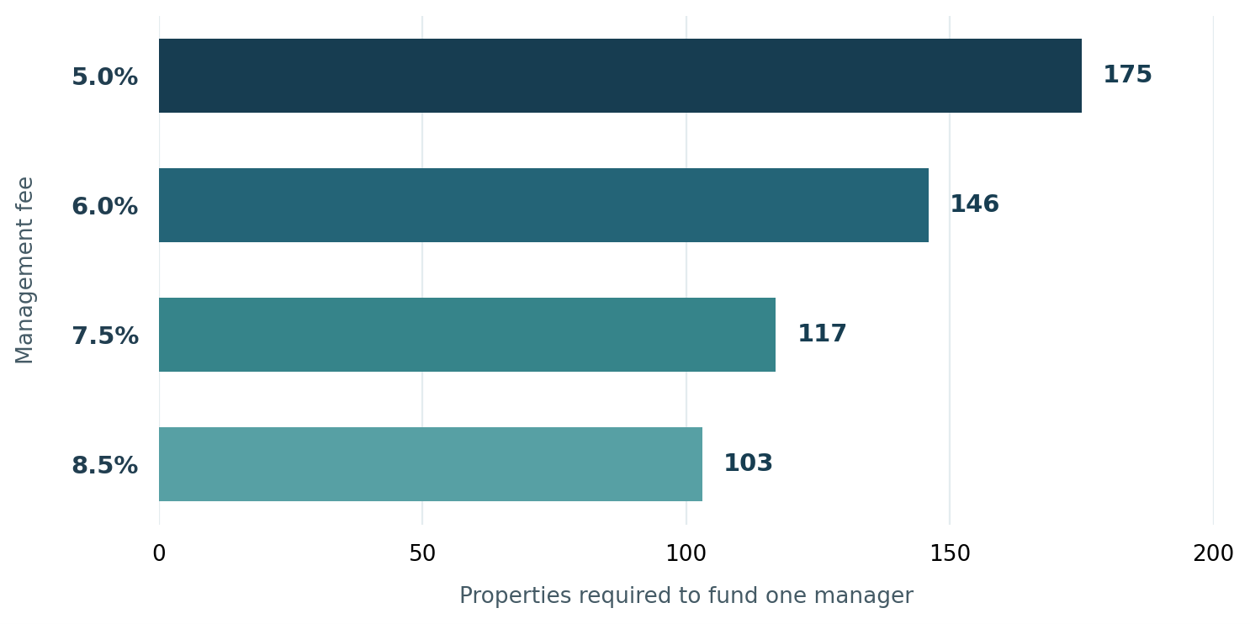
Illustrative workload comparison based on the assumptions above. Not actual competitor portfolio sizes.
The difference is considerable.
Under this model, a company charging 5% would need around 175 properties to generate the same contribution towards employing a manager that a company charging 7.5% could generate from approximately 117.
Different companies have different operating costs, so these numbers don't represent every business.
But the underlying principle remains.
If a company charges significantly less, it needs to make up that difference somewhere. That might be through lower overheads, additional fees, a different level of service or higher property manager workloads.
Over my years working in property management, I've yet to come across a genuinely low-cost provider that consistently delivers the same level of service without making compromises somewhere.
For landlords, it's worth understanding what those compromises might mean.
The cost of a property manager who's stretched too thin
The financial impact of poor property management often has very little to do with the management fee itself.
Consider a rental property earning $660 per week.
One additional week of vacancy means $660 in lost rental income.
A maintenance issue that isn't followed up promptly can become a much more expensive repair.
Poor tenant selection can lead to arrears, damage and disputes that take considerable time and money to resolve.
And if a property manager is looking after too many properties, they may have less time to deal with these issues before they become serious.
It's not necessarily a question of whether the manager is experienced or hardworking. Even a very capable person can struggle when their workload becomes excessive.
That's why landlords should ask how many properties their manager looks after, who provides support when they're unavailable and how the company handles unexpected problems.
The quality of those answers can tell you considerably more than the management percentage alone.
Why experienced property managers and long-term relationships matter
At Crockers, our property managers generally look after around 100 to 130 properties each. That gives them time to get to know the properties and landlords they manage.
Just as importantly, they tend to stay.
Our property managers have an average tenure of approximately eight years, with some having been with Crockers for more than 26 years. Many long-standing landlords have dealt with the same manager for most, if not all, of their time with us.
That continuity means the history of a property doesn't have to be rediscovered every time a tenant changes.
A long-serving manager knows what repairs have been completed, which issues have come up before and how a property's condition has changed over time.
It's particularly useful when a tenant says, "That damage was already there when I moved in."
Inspection reports and photographs remain essential, but there's also real value in having someone who remembers previous tenancies and knows the property's history.
When property managers change regularly, some of that knowledge can be lost, even with good record-keeping.
In some cases, our property managers know more about a property's day-to-day history than the landlord does.
When you're managing an investment worth hundreds of thousands, or even millions of dollars, that knowledge and continuity are worth protecting.
It's one of the reasons we place so much importance on retaining experienced staff.
How Crockers experience and size benefit landlords
Crockers has been managing rental properties in Auckland since 1971 and manages approximately 4,500 properties across the region.
That experience and scale allow us to invest in the systems, processes and support teams needed to manage properties effectively.
Our property managers are supported by people handling other functions, including administration, accounts and leasing. This allows them to concentrate on managing their landlords' properties rather than having to do everything themselves.
We've also developed established relationships with a wide range of contractors and service providers.
Having experienced tradespeople, reliable maintenance processes and established systems helps us manage repairs and other property issues efficiently.
None of this means a large company is automatically better than a smaller one. There are some very capable boutique property management companies in Auckland.
What matters is whether the business has the people, experience and systems to consistently deliver the service it's promising.
We've explored this in more detail in our article on large versus boutique property management companies in Auckland.
What should you consider when comparing property managers?
Before choosing a property manager, we'd suggest looking beyond the advertised fee and asking a few practical questions.
How many properties does each manager look after?
This gives you an indication of their workload and the time they're likely to have available for your property.
How long do your property managers typically stay?
Staff continuity can make a significant difference, particularly when a manager has looked after the same property through several tenancies.
How are tenants selected?
Ask about background checks, credit checks, references and how prospective tenants are assessed.
How are maintenance issues managed?
Understand how contractors are selected, how repairs are approved and what happens when something urgent arises.
What happens when my property manager is away?
Find out who provides cover and whether they have access to your property's records and history.
What will I actually pay?
Ask for a written breakdown of the management fee and any additional charges so you can compare the total cost.
For a detailed breakdown of Auckland fees and services, see our companion guide, Property Management Fees in Auckland.
Good property management should protect your investment
The cheapest management fee isn't necessarily the best value, just as the highest fee doesn't guarantee the best service.
What matters is having an experienced property manager who has the time, knowledge and support to look after your property properly.
At Crockers, our approach is to charge a fair fee that allows us to employ experienced staff, provide manageable workloads and invest in the systems needed to deliver a reliable service.
The aim isn't to be the cheapest.
It's to protect our landlords' properties, minimise avoidable costs and help maintain their rental income over the long term.
If you're considering professional property management or thinking about changing providers, we're happy to discuss how we could look after your property.

